
Crack your Sarkari exam with real-pattern mock tests
UPPSC, BPSC, UPSC and more. Timer, negative marking, rank and full solutions, exactly like the exam hall.
✓ Full length, real pattern✓ Rank and solutions✓ Free registration or try today’s sample questions →
From a free mock to your rank in 3 steps
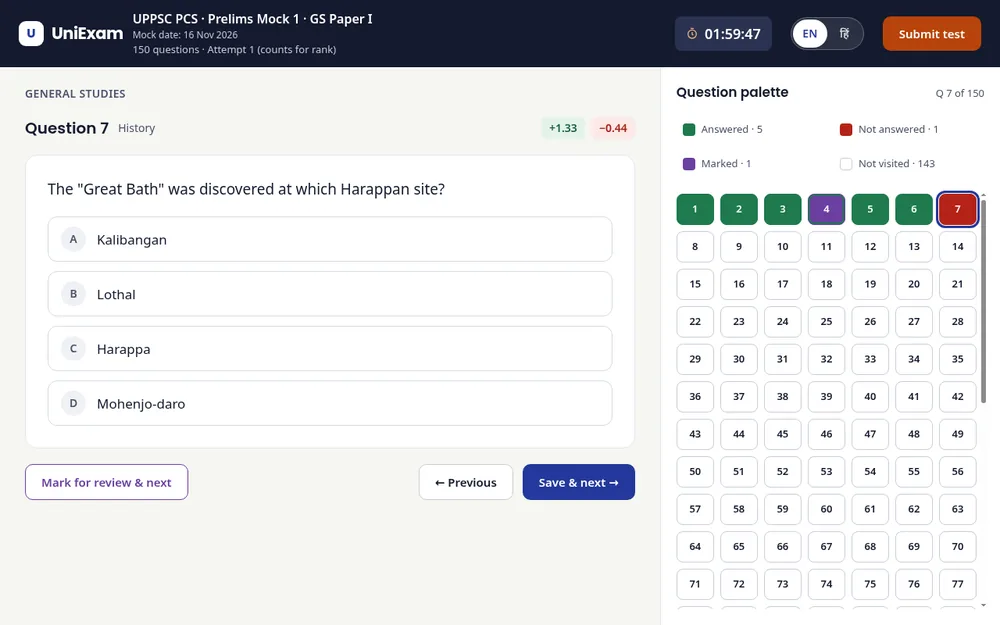
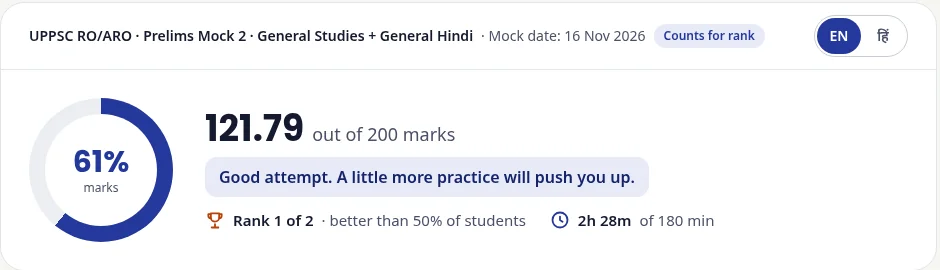
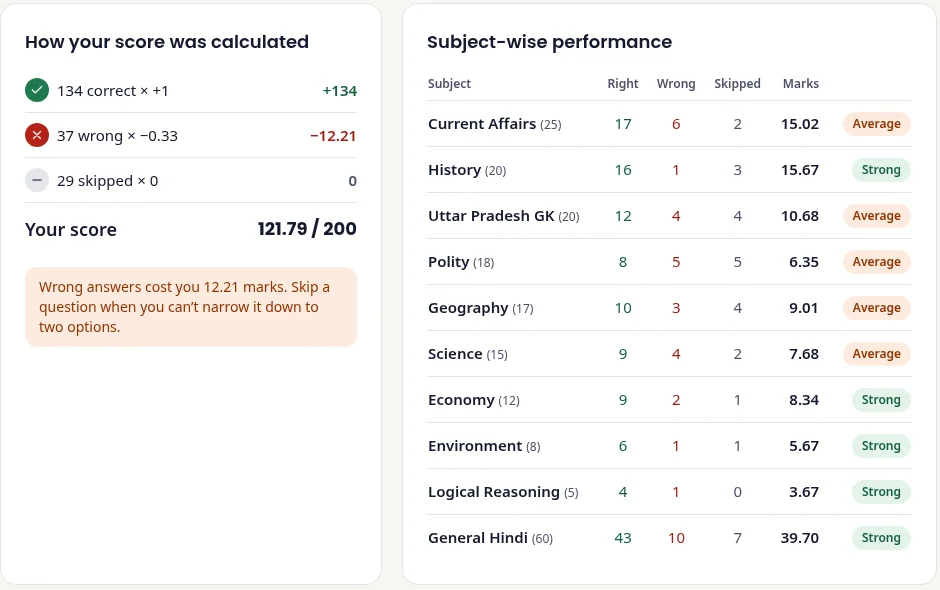
This is the real test screen and result analysis every student gets.
- Choose your exam — UPPSC, UPSC, BPSC, PCS-J and more, each in its official pattern.
- Take the full mock — Timer, question palette, mark for review and negative marking, in Hindi or English.
- Get your rank and analysis — Score, rank among all students, subject-wise accuracy and every solution.
What are you preparing for?
Mock tests, daily mocks and practice questions in Hindi and English. More exams are on the way.
- UPPSC RO/ARO Mock Test — UPPSC Review Officer / Assistant Review Officer. 22 mock tests · Daily mock · Free full-length demo mock. UPPSC RO/ARO syllabus & pattern · Mock test results & toppers (UPPSC RO/ARO) · UPPSC RO/ARO previous year papers (solved)
- UP PCS J Mock Test — UPPSC PCS (J) – Civil Judge (Junior Division). 10 mock tests · Daily mock · Free full-length demo mock. UP PCS J syllabus & pattern · Mock test results & toppers (UP PCS J) · UP PCS J previous year papers (solved)
- UPPSC PCS Mock Test — Uttar Pradesh Public Service Commission. 5 mock tests · Daily mock · Free full-length demo mock. UPPSC PCS syllabus & pattern · Mock test results & toppers (UPPSC PCS) · UPPSC PCS previous year papers (solved)
- UPSC CSE Mock Test — Union Public Service Commission. 4 mock tests · Daily mock · Free full-length demo mock. UPSC CSE syllabus & pattern · Mock test results & toppers (UPSC CSE)
- BPSC CCE Mock Test — Bihar Public Service Commission. 1 mock test · Daily mock · Free full-length demo mock. BPSC CCE syllabus & pattern · Mock test results & toppers (BPSC CCE)
- UPSSSC PET Mock Test — Preliminary Eligibility Test. 1 mock test · Daily mock · Free full-length demo mock. UPSSSC PET syllabus & pattern · Mock test results & toppers (UPSSSC PET)
- UP TGT Social Science Mock Test — UP TGT (Trained Graduate Teacher) Social Science – UPESSC. 10 mock tests · Daily mock · Free full-length demo mock. UP TGT Social Science syllabus & pattern · Mock test results & toppers (UP TGT Social Science) · UP TGT Social Science previous year papers (solved)
Coming soon: MPPSC State Service, RPSC RAS, UKPSC PCS, UPSC NDA, UPSC CDS, UPSC CAPF, Bihar Judiciary (BPSC J), MP Civil Judge, Rajasthan Judiciary (RJS), UP Police Constable, UP Police SI, UPSSSC Lekhpal, UPSSSC VDO, SSC CGL, SSC CHSL, SSC MTS, SSC GD Constable, SSC CPO, RRB NTPC, RRB Group D, RRB ALP, UPTET, CTET, UP Super TET, BPSC TRE, IBPS PO, IBPS Clerk, SBI PO, SBI Clerk
Try today’s questions from your exam
10 UPPSC RO/ARO questions from your syllabus in the real exam style, hard ones first: statements, match the lists, assertion–reason. A new set every day.
-
Consider the following statements: 1. Muhammad bin Tughlaq introduced token currency in bronze/copper. 2. Muhammad bin Tughlaq set up the Diwan-i-Amir-Kohi to promote agriculture. Which of the statements given above is/are correct? Select the correct answer using the codes given below.
- (A) Both 1 and 2
- (B) Only 1
- (C) Only 2
- (D) Neither 1 nor 2
Answer: (A) Both 1 and 2
Muhammad bin Tughlaq issued token coins to be valued like silver, and created the Diwan-i-Amir-Kohi, a department of agriculture to bring more land under cultivation. Both statements are correct.
-
Under Section 81 of the Representation of the People Act, 1951, an election petition must be presented within how many days from the date of election of the returned candidate?
- (A) 30 days
- (B) 45 days
- (C) 90 days
- (D) 60 days
Answer: (B) 45 days
An election petition must be filed in the High Court within 45 days from the date of election of the returned candidate.
-
Match List-I with List-II and select the correct answer using the codes given below the lists: List-I (Bharat Ratna recipient from UP) List-II (Year of award) (A) Dr. Bhagwan Das 1. 1966 (B) Govind Ballabh Pant 2. 1961 (C) Purushottam Das Tandon 3. 1955 (D) Lal Bahadur Shastri 4. 1957
- (A) A-3, B-4, C-2, D-1
- (B) A-3, B-4, C-1, D-2
- (C) A-4, B-3, C-2, D-1
- (D) A-3, B-2, C-4, D-1
Answer: (A) A-3, B-4, C-2, D-1
The Varanasi philosopher Dr. Bhagwan Das received the Bharat Ratna in 1955, G. B. Pant in 1957, "Rajarshi" P. D. Tandon in 1961 and Lal Bahadur Shastri (born at Mughalsarai) posthumously in 1966.
-
Consider the following statements: 1. The Mahi river crosses the Tropic of Cancer twice. 2. The Mahi falls into the Gulf of Khambhat. 3. The Mahi rises in the Aravalli hills of Gujarat. Which of the statements given above is/are correct? Select the correct answer using the codes given below.
- (A) Only 2 and 3
- (B) 1, 2 and 3
- (C) Only 1 and 3
- (D) Only 1 and 2
Answer: (D) Only 1 and 2
The Mahi rises in the Vindhyan hills of Madhya Pradesh, flows north into Rajasthan, turns back south-west through Gujarat and falls into the Gulf of Khambhat, crossing the Tropic of Cancer twice. Statement 3 is wrong.
-
Match List-I with List-II and select the correct answer using the codes given below the lists: List-I (Five-Year Plan) List-II (Model / objective) (A) First Plan 1. "Food, work and productivity" (B) Second Plan 2. Mahalanobis model, emphasis on basic and heavy industries (C) Fourth Plan 3. Harrod–Domar model, priority to agriculture (D) Seventh Plan 4. "Growth with stability and progressive achievement of self-reliance"
- (A) A-3, B-2, C-1, D-4
- (B) A-2, B-3, C-4, D-1
- (C) A-4, B-2, C-3, D-1
- (D) A-3, B-2, C-4, D-1
Answer: (D) A-3, B-2, C-4, D-1
The First Plan (1951–56) used the Harrod–Domar model and gave priority to agriculture and irrigation; the Second (1956–61) followed P. C. Mahalanobis’s model of heavy industrialisation; the Fourth (1969–74) aimed at "growth with stability and progressive achievement of self-reliance"; the Seventh (1985–90) stressed "food, work and productivity".
-
Which is NOT a synonym of "आम"?
- (A) रसाल
- (B) आम्र
- (C) सहकार
- (D) कदली
Answer: (D) कदली
कदली is banana; रसाल, आम्र and सहकार mean mango.
-
Given below are two statements, one is labelled as Assertion (A) and the other as Reason (R). Assertion (A): India usually records a surplus on the invisibles account of its balance of payments. Reason (R): India earns large receipts from exports of services such as software and from private transfers (remittances). Select the correct answer from the codes given below:
- (A) Both (A) and (R) are true, but (R) is not the correct explanation of (A)
- (B) (A) is false, but (R) is true
- (C) Both (A) and (R) are true and (R) is the correct explanation of (A)
- (D) (A) is true, but (R) is false
Answer: (C) Both (A) and (R) are true and (R) is the correct explanation of (A)
Both are true and (R) explains (A). Invisibles cover services, transfers and income. Large software exports and remittances, India being the world's largest recipient of remittances, give a surplus that offsets much of the merchandise trade deficit.
-
With reference to the idol of Ram Lalla consecrated in the Shri Ram Janmabhoomi temple, Ayodhya, on 22 January 2024, which one of the following is correct?
- (A) It was carved from white Makrana marble by a Jaipur sculptor.
- (B) It was sculpted by Arun Yogiraj of Mysuru from black stone.
- (C) It was cast in bronze by Ram V. Sutar.
- (D) It was made of red sandstone from Bansi Paharpur.
Answer: (B) It was sculpted by Arun Yogiraj of Mysuru from black stone.
The 51-inch idol of the five-year-old Ram Lalla was carved by Arun Yogiraj from Krishna shila (black schist) quarried near Mysuru; the Pran Pratishtha was performed with the Prime Minister present. Bansi Paharpur pink sandstone was used for the temple structure, not the idol. (Source: Shri Ram Janmabhoomi Teerth Kshetra; PIB, January 2024)
-
Consider the following statements: With reference to the National Calendar of India: 1. The Saka calendar was adopted as the National Calendar from 22 March 1957. 2. Its first month is Chaitra. 3. In a normal year, 1 Chaitra falls on 22 March of the Gregorian calendar. Which of the statements given above is/are correct? Select the correct answer using the codes given below.
- (A) Only 1 and 3
- (B) Only 2 and 3
- (C) Only 1 and 2
- (D) 1, 2 and 3
Answer: (D) 1, 2 and 3
All three are correct. On the Calendar Reform Committee's recommendation (chaired by Meghnad Saha), the Saka-era calendar was adopted from 1 Chaitra 1879 (22 March 1957). Chaitra is the first month, and 1 Chaitra falls on 22 March in a normal year and on 21 March in a leap year.
-
Among the students of a class who passed an examination, Seema ranks 12th from the top and 29th from the bottom. If 6 students failed and 4 did not appear, how many students are there in the class?
- (A) 50
- (B) 40
- (C) 46
- (D) 44
Answer: (A) 50
Students who passed = 12 + 29 − 1 = 40. Adding those who failed (6) and those who did not appear (4): 40 + 6 + 4 = 50 students in the class.
Exam-wise fees
Pay only for the exam you are preparing for. Valid for 1 year from purchase.
- UPPSC PCS: ₹399 / year — 5 full-length mock tests, 10 / 50 / 100-question practice sets.
- UPSC CSE: ₹799 / year — 4 full-length mock tests, 10 / 50 / 100-question practice sets.
- UPPSC RO/ARO: ₹299 / year — 22 full-length mock tests, 10 / 50 / 100-question practice sets.
- BPSC CCE: ₹499 / year — 1 full-length mock test, 10 / 50 / 100-question practice sets.
- UPSSSC PET: ₹299 / year — 1 full-length mock test, 10 / 50 / 100-question practice sets.
- UP PCS J: ₹499 / year — 10 full-length mock tests, 10 / 50 / 100-question practice sets.
- UP TGT Social Science: ₹299 / year — 10 full-length mock tests, 10 / 50 / 100-question practice sets.
Questions aspirants ask
Is Take A test free?
You can try free sample questions without signing up. After free registration you get one full-length demo mock in every exam and 10-question practice sets. Buy an exam to unlock all its mock tests, the daily mock and 50/100-question practice sets for a year.
Are tests available in Hindi?
Yes. Every question, option and explanation is available in Hindi and English. You can switch language at any time, even during a test.
Is it like the real exam?
Yes. The test screen has a timer, question palette, mark for review and negative marking, similar to the computer-based exams.
How is my rank decided?
Mock tests can be taken once, and that attempt sets your rank. Ties go to the student who took less time, then higher accuracy. For unlimited practice, use practice sets, which are never ranked.
How does pricing work?
Each exam has its own annual fee, shown in the exam-wise fees list. If you buy more than one exam in the same order, each additional exam is 60% off.
Can I use it on my phone?
Yes. Take A test works in your phone’s browser. No app download is needed.